
How to Secure a Sliding Glass Door
In Central Florida, the back patio slider is the door a burglar likes best. It’s hidden from the street behind a fence or hedge, the factory latch is a flimsy hook, and on older doors the whole panel can be lifted out of its track without a single tool. The good news: you don’t replace the door to fix this. You harden it in layers — and the strongest layers cost less than you’d guess. Here’s the order Speedy installs them in, strongest first.
Layer 1: Upgrade the factory latch to a real commercial lock
The lock that came on your door is a small spring-loaded hook that catches a strike in the frame. Give it a firm shake and you can often feel it rattle loose. That’s the single weakest link on the whole door.
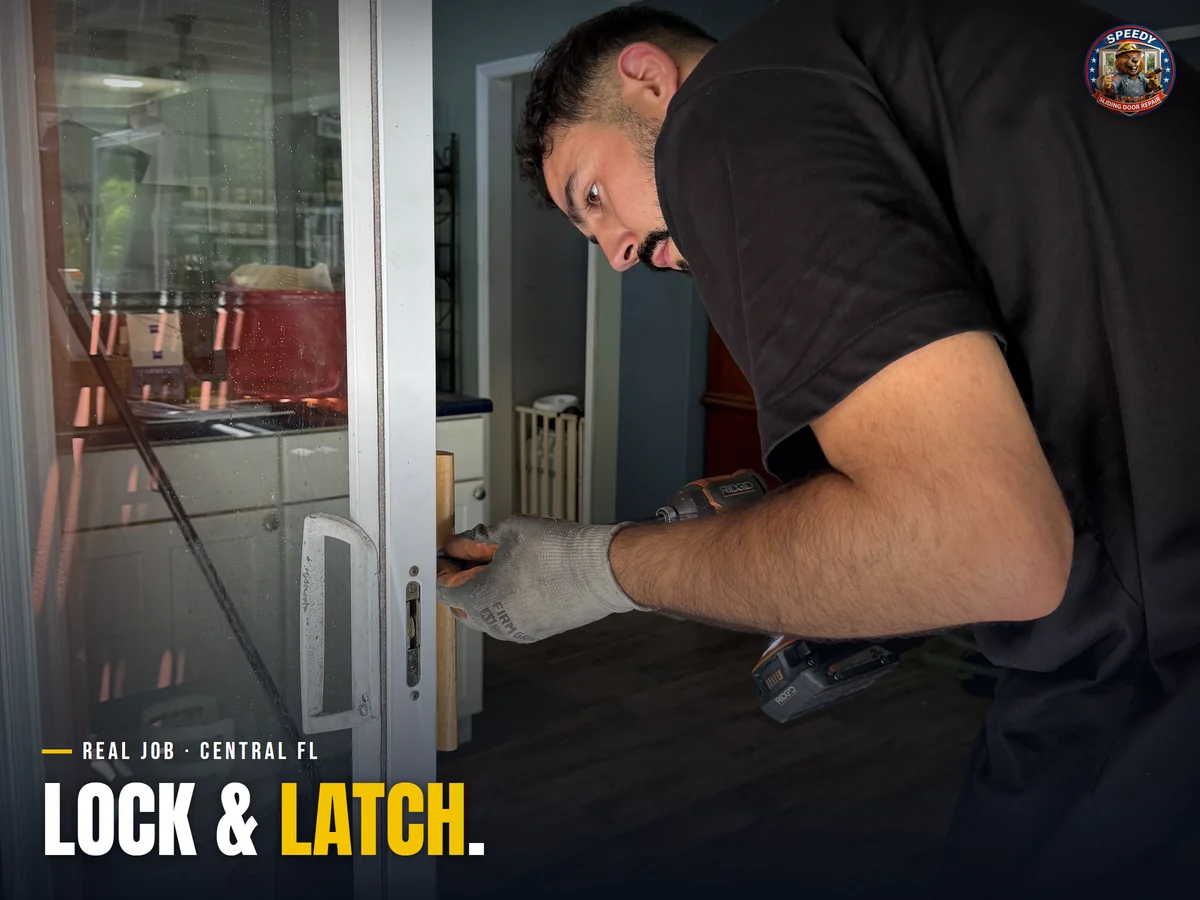
The fix is a stronger commercial mortise lock at the meeting rail — a heavier latch with a deeper throw and a solid strike that doesn’t flex when the door is jostled. This is the backbone of the whole system, and it’s exactly what our Lock System Repair & Upgrade service handles. It’s a single-visit job, and we’ll tell you for free whether your existing lock is salvageable or needs replacing.
Layer 2: Add a secondary lock — foot bolt or pin lock
One locking point is one point of failure. A secondary lock down near the floor changes the geometry of an attack completely — now the door is pinned at two heights, so prying the top does nothing.
Foot bolt
A foot bolt mounts low on the moving panel and drops a steel bolt down into a hole drilled in the sill. You tap it with your foot to lock, lift to release. Simple, cheap, and brutally effective — the door physically cannot slide with the bolt seated.
Pin lock
A pin lock runs a hardened steel pin straight through the inner frame of the moving panel and into the fixed panel behind it. It locks both panels together as one unit. People also use these to lock a door in a partly-open position for ventilation without leaving it slideable.
Layer 3: Install anti-lift pins so the panel can’t be lifted out
Here’s the trick most homeowners have never heard of. On many sliders there’s a gap above the panel in the upper track. Lift the door up into that gap, tilt the bottom out, and the whole panel comes free of its channel — lock still “locked,” door wide open. No noise, no tools.
Anti-lift pins kill this. They’re screws or steel pins set into the head track so the gap above the panel shrinks to nothing. With nowhere to lift into, the door stays in its channel no matter how hard someone heaves on it. This is the layer that defeats the quietest break-in, and it’s the one we most often add that a homeowner didn’t know existed.
Layer 4: Add a security bar or dowel
The classic. A charley bar folds down from the frame and braces against the moving panel; a cut wooden dowel or a length of PVC laid in the lower track does the same job for a few dollars. Either one physically blocks the door from sliding open, and a thief can see it through the glass — which is half the value. It’s a deterrent before it’s ever a barrier.
The catch: a bar does nothing against lifting, and it only works when you remember to set it. Treat it as the visible top layer on a door that’s already hardened underneath — not as your one and only lock.
Layer 5: Make sure the door actually closes — or none of it works
This is the layer everyone skips, and it quietly defeats all the others. The best commercial lock on earth can’t engage if the panel stops two inches short of the jamb. Worn rollers and a dirty track are the usual reasons a Florida slider won’t seat all the way — and a door that won’t fully close is a door you stop bothering to lock.
If your slider drags, sticks, or stops short, fix that first. Clean the track, check the rollers, and confirm the lock seats with a satisfying click every time. If it won’t, read why your sliding glass door won’t lock — that’s the root cause to clear before any hardware upgrade is worth installing. Sometimes the real security fix is a roller replacement so the door closes flush again.
What it costs to harden your slider
You don’t need every layer on day one. Here’s how the pieces stack up so you can prioritize:
| Layer | What it stops | Speedy service |
|---|---|---|
| Commercial latch upgrade | Prying & shaking the door open | Lock System Repair & Upgrade — single visit |
| Foot bolt / pin lock | Sliding with one latch defeated | Added during lock upgrade |
| Anti-lift pins | Lifting the panel out of its track | Added during lock upgrade |
| Security bar / dowel | Sliding (visible deterrent) | DIY-friendly; we’ll fit one |
| Door closes fully | Lock never engaging at all | Roller Replacement from $89 |
Lock work is priced as a single-visit repair after we see the door — there’s no flat number that fits every lock, so we give you a real figure on a free diagnosis instead of guessing. If the slider also needs to glide and seat properly, Roller Replacement starts at $89 and Track Repair at $99. Everything we install carries a 1-year warranty on parts.
DIY or call Speedy?
Honest answer: a security bar and a basic pin lock are weekend DIY — buy them, set them, done. Where homeowners get stuck is the commercial latch swap and the anti-lift pins, because those have to be sized and seated to your exact frame, and a pin set a hair wrong either won’t hold or jams the door. That’s the part we do every day across cities in Central Florida, and it’s the part worth a pro. We don’t upsell — if your door just needs a $20 bar and a clean track, we’ll tell you that.
Frequently asked
What is the most common entry point for a burglar?
In Florida homes, the back sliding glass door is one of the most common forced-entry points. It’s out of view from the street, the factory latch is weak, and an older panel can sometimes be lifted out of its track. Hardening the slider is the highest-value security upgrade most homeowners can make.
Can you add a deadbolt to a sliding glass door?
Not a traditional swing-door deadbolt, but you can add a surface-mounted foot bolt or pin lock that drops a steel pin into the frame, plus a stronger commercial mortise latch. Together those give you deadbolt-grade holding power without drilling the glass.
How do anti-lift pins stop a break-in?
Anti-lift devices are screws or pins set into the upper track so the gap above the panel shrinks. With the gap gone, the door can’t be lifted up and tilted out of its channel — which closes off a quiet, no-tools way into the home.
Is a security bar enough on its own?
A charley bar or dowel is a good visible deterrent and blocks the door from sliding, but it does nothing against lifting and is easy to skip on a busy day. Use it as one layer on top of a stronger latch, a secondary lock, and anti-lift pins — not as your only defense.
Get My Free Estimate →📞 (321) 204-2545