
How to Lubricate a Sliding Door
Want a 5-minute fix that solves 40% of sliding door problems? Lube the track and rollers correctly. Want to cause a roller problem? Lube them with the wrong stuff. Here’s the difference.

Rather have it fixed today? If lube didn’t fix it, that’s your diagnosis. Speedy comes to you across Orlando, Kissimmee and Central Florida, usually the same day. The estimate is free, you approve the price before any work starts, and every repair carries a 1-year warranty on parts.
The 3 lubricants that work
1. Silicone spray (best, easy to find)
Pure silicone spray. Available at any hardware store for $8. Look for “silicone lubricant” on the label. NOT “silicone caulk” (that’s sealant), NOT “silicone grease” (too heavy).
2. Dry teflon spray (cleanest)
PTFE/teflon spray. About $12. Goes on wet, dries to a slick film. Doesn’t attract dust like wet lubricants. Best for households with pets or sandy yards.
3. White lithium grease (heaviest, longest-lasting)
For stubborn rollers. About $10. Use sparingly — a little goes a long way. Don’t use this on the track surface, only on the roller pivot.
The 3 things you MUST NOT use
1. WD-40 (the #1 mistake)
WD-40 is a solvent and degreaser, not a lubricant. It washes away protective coatings, then evaporates, leaving the metal even drier. Within a week the door is worse than before. Don’t use it.
2. Olive oil, cooking oil, vaseline
All of these go rancid, attract dust, and gum up the rollers. You’ll have a sticky mess in 6 months and need a real cleaning.
3. Hair spray, furniture polish, leather conditioner
People try this. The internet recommends it. It always ends in a service call.
The 5-minute lubrication procedure
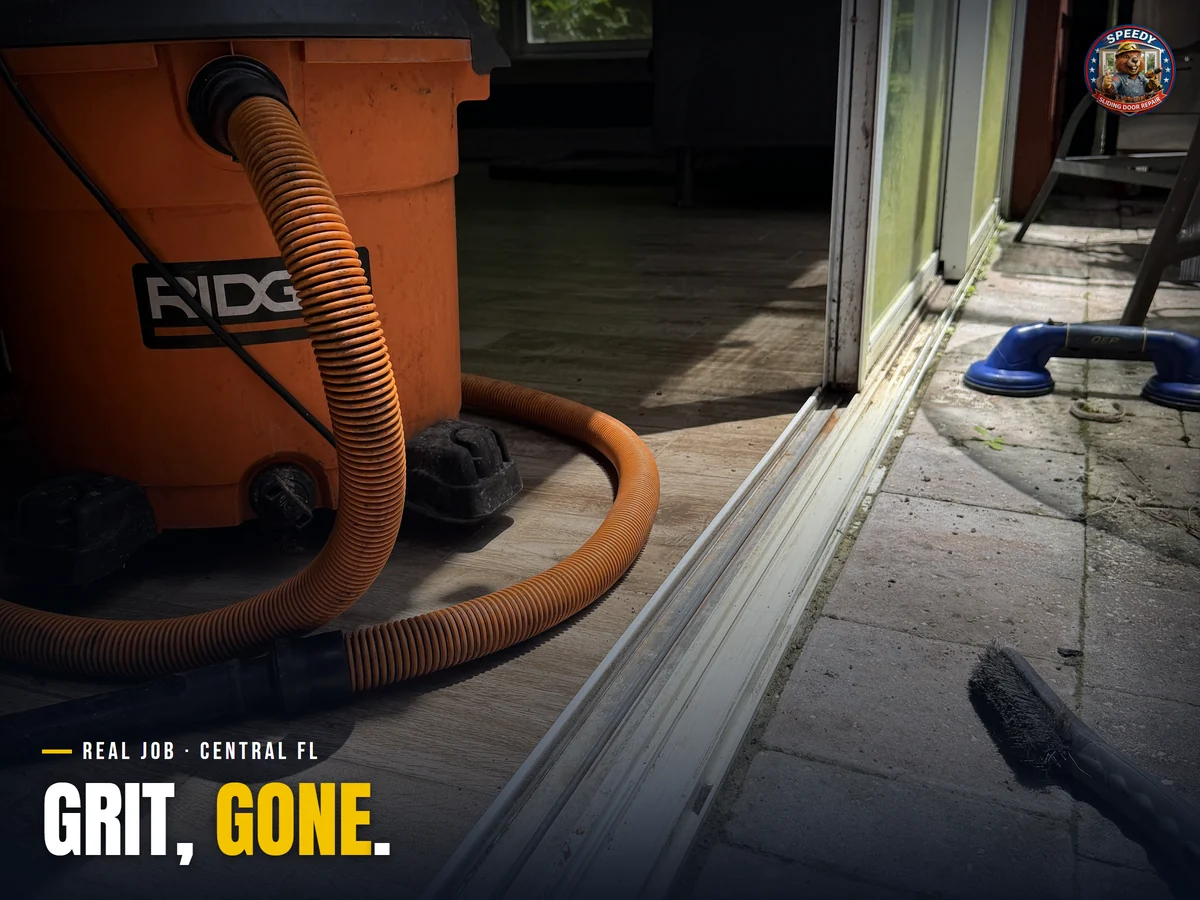
- Vacuum first. Shop vac with brush attachment. Both the bottom and top tracks. Get pet hair, sand, debris.
- Damp wipe. Microfiber with water (no soap, no chemicals). Run it along the entire track to pick up the residue the vacuum missed.
- Dry the track. Same microfiber, dry. Important — lubricant on wet metal doesn’t bond.
- Spray the track. Light, even coat of silicone or teflon. Don’t soak it.
- Slide the door 10 times. Open, close, open, close. This redistributes the lube and tells you if there’s a real problem.
If lubrication doesn’t fix it — that’s the diagnosis
Here’s the trick: a sliding door that’s just dirty will glide silently after step 5. A sliding door with worn rollers will still grind. A sliding door with a damaged track will still catch in the same spot. A sliding door with alignment issues will still bind.
So this DIY is also a diagnostic. If lubrication didn’t fix it, you’ve narrowed the problem down to mechanical, and now a service call makes sense.
How often should I lubricate?
- Florida coastal (within 5 mi of ocean): every 3 months
- Florida inland: every 6 months
- House with pets: more frequent vacuum, lube every 4 months
- Snowbirds (door used 6 mo/yr): lube before and after the offseason
When DIY isn’t enough
If the door grinds or sticks even after a thorough clean and proper lube, you’re not solving it with a spray can. Most likely cause: worn rollers (8+ years old). Roller replacement brings the door back to factory glide.
Speedy handles sliding glass door repair in Orlando, Kissimmee and across Central Florida — we fix the door you already have. Fix it, don’t replace it.
Already tried it? Let Speedy fix it. Free estimate before any work, and a 1-year warranty on parts.
Our Central Florida Sliding Door Failure Report found that 77% of the homes that described a problem had a roller or glide issue — only 2% involved the glass or frame.
Frequently asked
What is the best lubricant for a sliding door?
The best lubricant for a sliding door is pure silicone spray or dry teflon (PTFE) spray. Both are available at any hardware store for $8–$12. Never use WD-40 (it is a degreaser, not a lubricant).
Can I use WD-40 on a sliding door?
No, never use WD-40 on a sliding door. WD-40 is a degreaser, not a lubricant. It washes away protective coatings and makes the door worse within a week.
How often should I lubricate my sliding door in Florida?
Lubricate a sliding door every 3 months on the Florida coast and every 6 months inland. More often if you have pets or sandy yards.
What if lubrication doesn’t fix the problem?
You’ve diagnosed mechanical wear — rollers, track, or alignment. Time for a service call.
Get My Free Estimate →📞 (321) 204-2545