
How to Adjust Sliding Door Rollers
A sliding door that drags on the floor, sits crooked in the frame, or leaves an uneven gap along the top usually doesn’t need new parts — it needs its rollers adjusted. Every sliding glass door rides on two rollers with a height screw at each bottom corner, and those screws are meant to be turned. Learning how to adjust sliding door rollers is about a 15-minute job with a screwdriver, and it’s the first thing to try before you call anyone. The one catch: adjustment only works if the rollers are still good. If they’re worn flat, this guide will tell you that too — and what the fix costs.
Rather have it fixed today? If the adjustment screw is maxed out, the rollers are worn. Speedy comes to you across Orlando, Kissimmee and Central Florida, usually the same day. The estimate is free, you approve the price before any work starts, and every repair carries a 1-year warranty on parts.
What adjusting the rollers actually does
At the bottom of your sliding panel are two small wheels — the rollers — that carry the entire weight of the door. Behind each bottom corner is a threaded height-adjustment screw. Turning it pushes the roller down (raising that corner of the door) or pulls it up into the door (lowering that corner). That’s the whole mechanism: you’re fine-tuning how high each end of the panel rides so it sits level and clears the track cleanly.
Doors drift out of adjustment on their own over time. The house settles, the rollers compress a little, and the panel starts riding low on one side. In Central Florida, sand and grit packing into the track speeds it up, and humidity swelling the frame does the rest. A quick turn of the screws brings the door back to a factory-level glide — no parts, no service call.
Before you adjust: is it really the rollers?
Adjustment fixes a door that’s slightly off — a light drag, a corner that scuffs, an uneven reveal at the top. It won’t save a door whose rollers are already destroyed. Do two quick checks first so you don’t spend 20 minutes chasing a screw that can’t win:
- Vacuum the track. A ridge of packed sand or a single pebble mimics a height problem exactly. Clear the channel and try the door again — sometimes that alone fixes it, and it always gives you a clean baseline before adjusting.
- Listen and feel. A door that’s just low will drag but still roll. A door that grinds, thuds over a flat spot, or has a roller that won’t spin has worn-out rollers — skip ahead to the replacement section.
How to adjust sliding door rollers (step by step)
All you need is a Phillips screwdriver or hex key (whichever your screws take), a shop vac, and a couple of minutes. A small level helps but your eye is usually enough.
- Locate the adjustment screws. Look at the bottom two corners of the moving panel. Pop off the small plastic caps (or find the finger holes) at each end of the bottom rail to expose the roller height screw.
- Clear the track first. Vacuum out the sand, grit, and pet hair so you’re adjusting against a clean channel. In Florida this step matters — packed grit fakes a height problem and throws off your reading.
- Raise or lower each side. Turn the screw clockwise to extend the roller and raise that corner, or counterclockwise to lower it. Work in quarter-turns and start with the corner that drags. A little goes a long way.
- Level the panel in the frame. Check the gap along the top edge and the latch stile against the jamb. Adjust each corner until the reveal is even top to bottom and the door sits plumb and square in the opening.
- Test the glide. Slide the door open and closed several times. It should roll smoothly the full length of the track with no dragging, scraping, or grinding.
- Re-check the latch alignment. Raising the door can shift the lock. Make sure the latch hook still lines up with the keeper and throws cleanly — nudge the roller height or the strike plate if it misses.
If a few quarter-turns bring the door back to a smooth, level glide, you’re done — that was a pure adjustment and it costs nothing. If you’re cranking the screw to its limit and the door still drags, stop. You’ve just diagnosed worn rollers.
When adjustment fixes it vs. when rollers are worn out
This is the whole decision in one table. Adjusting is free and takes minutes; replacing is a cheap repair that brings the door back to factory glide. The trick is knowing which one you’re looking at.
| What you’re seeing | What it means | Fix |
|---|---|---|
| Door drags slightly or the top gap is uneven | Out of adjustment | DIY roller adjustment (free) |
| Rides a hair low but otherwise rolls fine | Height drifted | DIY roller adjustment (free) |
| Grinding, scraping, or a flat-spot thud | Rollers worn out | Roller Replacement |
| Won’t hold the adjustment — drifts back low in days | Rollers collapsed | Roller Replacement |
| Catches at one exact spot every time | Bent or pitted track | Track Repair |
| Binds top and bottom, out of square | Rollers + track + alignment | Full Restoration — free inspection |
What worn rollers cost to fix
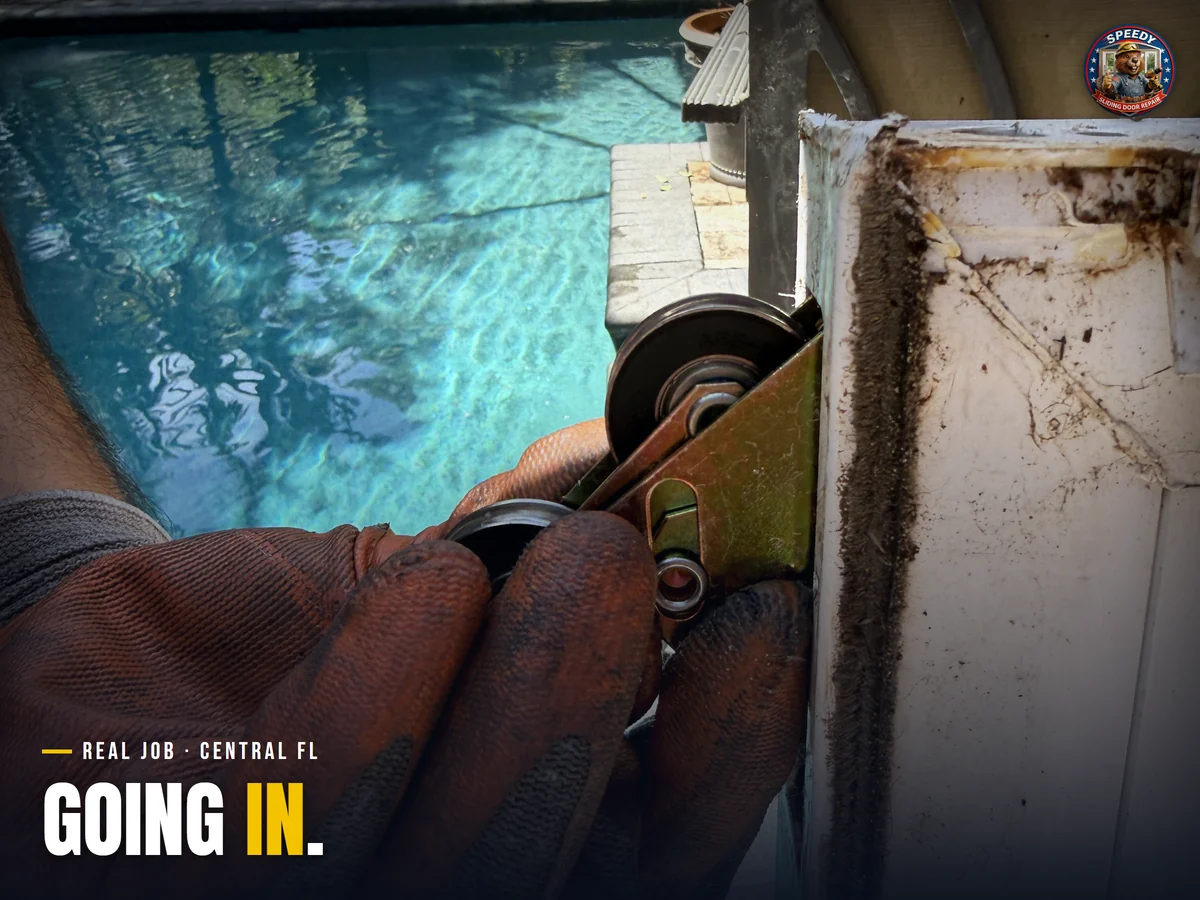
When adjustment can’t hold, the parts are cheap and the job is same-day. Roller replacement on a standard door usually falls under our Glide Restore package, and a second door costs less per door if you have more than one to do. New rollers drop the door back to a factory-smooth glide and give you the full height range back so it can be adjusted properly again.
If the reason the door won’t sit right is the track rather than the rollers — a bent lip or a pitted channel — track repair is the fix, and we cap worn tracks with marine-grade stainless. When both the rollers and the track are shot and the door binds all over, that’s a full restoration, priced after a free on-site inspection. Every repair is mobile, backed by our 1-year warranty on parts, and priced up front: a price you approve before any work starts — a free estimate, never a guess over the phone.
The Florida angle: why your door drifts out of level
Central Florida is hard on sliding doors. Fine sand and lawn grit blow into the bottom track and pack down into a ridge that lifts the rollers unevenly, so a door that was perfectly adjusted last season starts scuffing this one. Summer humidity swells the frame and the panel, tightening the fit. And on the coast, salt air corrodes the roller bearings until they seize — that’s when adjusting stops working and the wheels need replacing outright.
It’s why pool-deck and lanai doors go out of adjustment fastest, and why we run these calls constantly from Orlando to Kissimmee. Keeping the track vacuumed out is the single best thing you can do to make an adjustment last.
When DIY won’t fix it
- The adjustment screw is turned all the way and the door still drags — the rollers are worn. See how we fix it →
- The wheels look flat, cracked or wobbly — replace them, don’t adjust them. See how we fix it →
- It still catches at one spot after adjusting — the track is bent or grooved. See how we fix it →
- The lock stopped lining up after adjusting — the keeper needs realigning. See how we fix it →
Speedy handles sliding glass door repair in Orlando, Kissimmee and across Central Florida — we fix the door you already have. Fix it, don’t replace it.
Already tried it? Let Speedy fix it. Free estimate before any work, and a 1-year warranty on parts.
Our Central Florida Sliding Door Failure Report found that 77% of the homes that described a problem had a roller or glide issue — only 2% involved the glass or frame.
Frequently asked
Which way do I turn the screw to raise a sliding door?
Turn the bottom roller-height screw clockwise to extend the roller and raise that corner, and counterclockwise to retract the roller and lower it. Work in small quarter-turns and start with the corner that drags.
How do I know if my rollers need adjusting or replacing?
Adjusting fixes a door that only drags slightly or shows an uneven gap along the top. If the door grinds, has flat spots, the roller won’t spin, or it won’t hold the adjustment and drifts back low within days, the rollers are worn out and need replacing.
Where are the adjustment screws on a sliding door?
They’re at the bottom two corners of the moving panel, usually hidden behind small plastic caps or inside finger holes at each end of the bottom rail. Pop the cap off and you’ll see a Phillips or hex screw that sets the roller height.
Why does my sliding door keep going out of adjustment?
Either the rollers are worn and can no longer hold their height, or Florida sand and grit have packed the bottom track so the door rides high and low in spots. If the door drifts back out of level within a few days of adjusting it, the rollers are shot and adjustment alone won’t hold.
Can I adjust sliding door rollers myself?
Yes. For most standard doors it’s a common DIY job that takes about 15 minutes with a screwdriver. Heavy impact-glass panels and doors with worn or seized rollers are a service call. Speedy diagnoses for free and carries universal-fit rollers on the truck.
Get My Free Estimate →📞 (321) 204-2545